
Water line repair and replacement
Your water service line brings water from the meter to the house, and when it fails you feel it right away: low pressure, a soggy yard or a water bill that makes no sense. We repair and replace water lines across Damascus and Montgomery County, often by digging only at the two ends.
Signs of a water line problem
- 01
Pressure dropped everywhere at once
One weak faucet is a fixture problem. The whole house losing pressure points to the line coming in.
- 02
A water bill that jumped
If your use has not changed and the bill has, water is going somewhere you cannot see.
- 03
Wet ground between the street and the house
A soggy strip or a spot that never dries, especially in dry weather, often sits right over a leak.
- 04
The meter moves with everything off
Turn off every tap and watch the meter. If it still moves, there is a leak.
- 05
Rusty or cloudy water
Old galvanized lines corrode from the inside and it shows up in the water.
- 06
An old line of unknown material
Galvanized steel, polybutylene and older lead service lines are all worth checking and replacing.
Repair or replace, and how we avoid a long trench
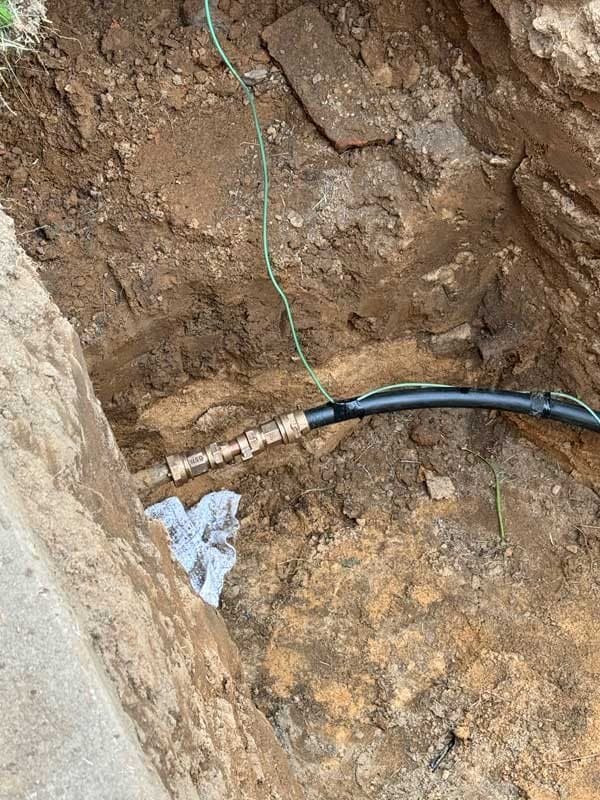
The water service line is usually the homeowner's responsibility from the meter to the house. When it leaks in one spot and the rest of the line is sound, a repair makes sense. We expose the leak, cut out the bad section and join in new pipe with proper fittings, like the repair in the photo at the top of this page.
When the line is old, has leaked more than once, or is made of a material that fails with age, replacing it is usually the better value. Patching one leak on a corroded galvanized line often just moves the problem a few feet down.
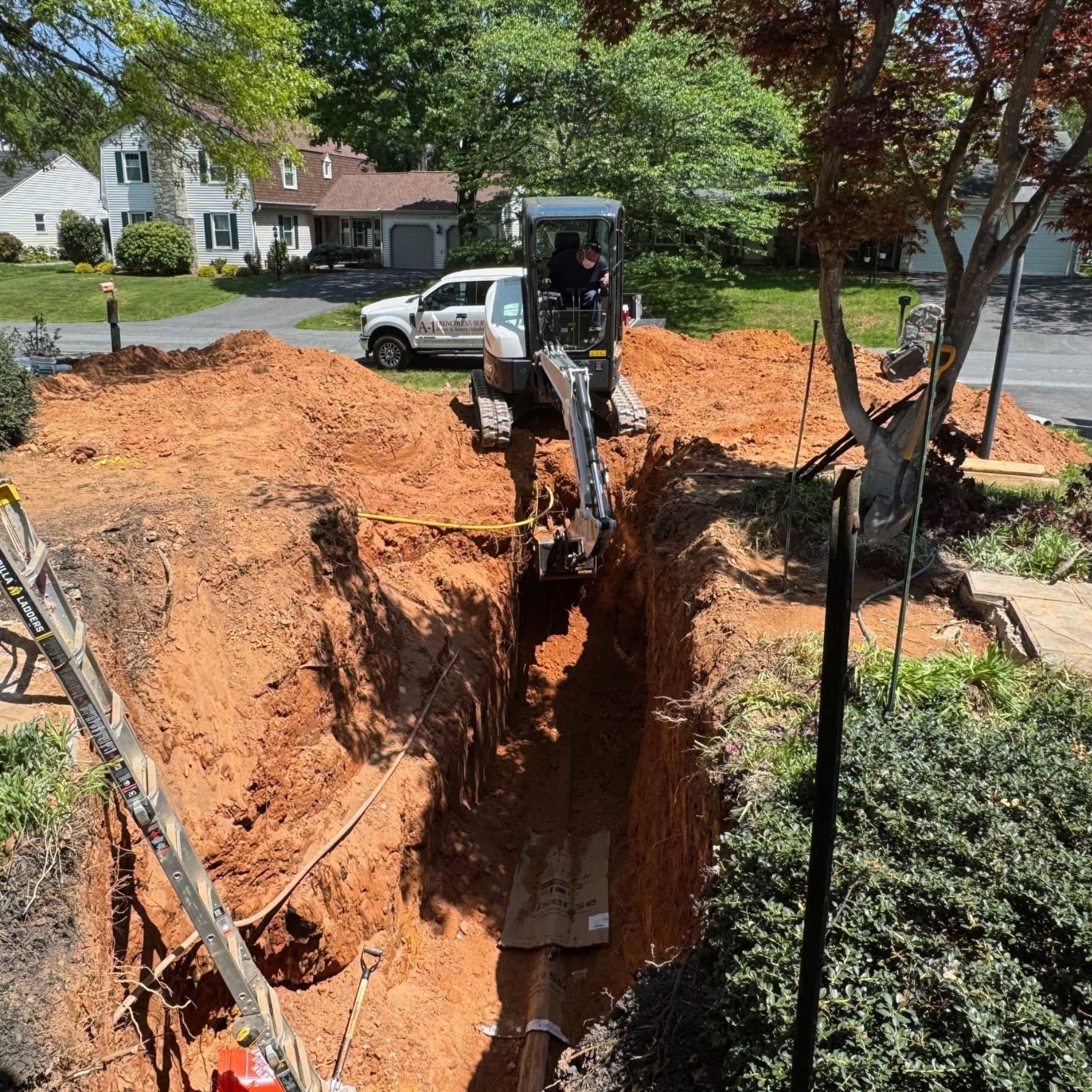
Replacement does not have to mean a trench across the lawn. On many lines, new pipe can be pulled in along the path of the old one by digging only at the two ends, near the meter and where the line enters the house. One of our customers described exactly that in a Google review: trenching only at the two ends, then pulling the new line through as the old one came out.
Some lines still need to be dug, for example when the route is blocked, the old pipe will not budge, or the line needs to move. When that happens we dig carefully, keep the trench as narrow as the job allows, and restore the lawn when we are done.
How a water line job goes
- 1
Confirm the leak
We check the meter, test the pressure and trace the line so we are fixing the right pipe.
- 2
Locate the line
We find the route from the meter to the house and have other utilities marked before digging.
- 3
Repair or replace
A section repair for a single leak, or a new line pulled or laid from the meter to the house.
- 4
Pressure test
We pressurize the new line and check every connection before backfilling.
- 5
Restore water and flush
Water back on, air and debris flushed out of the line, pressure checked at the fixtures.
- 6
Restore the ground
Backfill, compact and grade. Seed or sod where we dug.
Section repair or full replacement
| Section repair | Full replacement | |
|---|---|---|
| Best when | One leak on a line that is otherwise sound | Old, corroded or repeatedly leaking lines |
| Digging | One hole at the leak | Often just the two ends, sometimes a trench |
| What you get | The leak fixed | A new line from the meter to the house |
| Watch out for | More leaks on an aging line | More work up front, but it ends the cycle |
What affects the cost of water line work
We price water line work after we trace the line. These factors make the biggest difference.
Read the full cost guide- Length from meter to house
- Longer runs mean more pipe and more pulling or digging.
- Repair or replacement
- One section versus the whole line is the biggest difference.
- Pull or dig
- Pulling new line with two pits is usually less restoration than a trench.
- Surfaces and obstacles
- Driveways, walks, trees and other utilities in the path add work.
At home and at work
For homeowners
For homeowners, a water line problem is urgent because it affects everything from showers to the washer. We work to get water back on as quickly as the job allows, and we keep the disruption to the yard small.
Residential servicesFor businesses and property managers
For businesses, water line work is planned around when you can be without water. We give you a clear schedule and keep the work area safe around entrances and parking.
Commercial servicesWhen a line breaks under the house
One customer's water line broke under her house and, in her words on Google, the water company told her 147,000 gallons had gone into the drainage system. Her review says we were there right away, dug up the front yard, fixed the leak, refilled the trench and re-landscaped, and that two days later you could not tell we had been there. Not every job can be done without digging. Every job can be cleaned up properly.
Questions we hear about water line repair
In most cases the utility owns the line up to the meter and the homeowner owns the line from the meter to the house. We can help you figure out where your responsibility starts.
Often, yes. On many lines we dig only at the two ends and pull the new line through along the old path. Some lines still need a trench, and we will tell you which kind yours is.
Many residential replacements are done in a day. Longer lines, rock, or a lot of obstacles can stretch that out.
We use pipe that meets local code for water service. We will tell you what is going in and why before the job starts.
Yes, they are worth replacing. Galvanized steel corrodes from the inside and restricts flow, and lead service lines are being replaced for health reasons. Ask us to check yours.
It can be. Corrosion inside an old line, a partly closed valve, or a leak underground can all cause it. A pressure test and a look at the meter narrow it down quickly.
Where we do this work

Water where it should not be?
Backups and broken lines get worse the longer water runs. Call us and tell us what you are seeing. We will tell you what to do right now and what it will take to fix it.
Monday to Friday, 8 AM to 5 PM. Free estimates on every job.