
Sewer camera inspections that show you the problem
A sewer video inspection puts a waterproof camera inside your line so nobody has to guess. We record the run from your house toward the street, mark every problem with its distance, and watch it with you.
Good reasons to put a camera in the line
- 01
The same clog keeps coming back
Something is catching debris. Roots, a sag or a broken joint are the usual suspects, and the camera tells you which.
- 02
You are buying a house
A home inspection rarely looks inside the sewer lateral. A camera inspection before closing can save you from inheriting a failed line.
- 03
Someone quoted you a full replacement
Before you pay to replace a whole line, it is worth seeing whether the damage is one spot or the whole run.
- 04
Soggy ground or a sewer smell outside
The camera and a locator show exactly where the break is, so any digging is small and in the right place.
- 05
The house is older and has never been checked
Clay and cast iron laterals age quietly. A baseline inspection shows how much life is left.
- 06
After a repair
A camera pass after lining or replacement shows the new pipe is clean and the connections are right.
What the camera actually finds
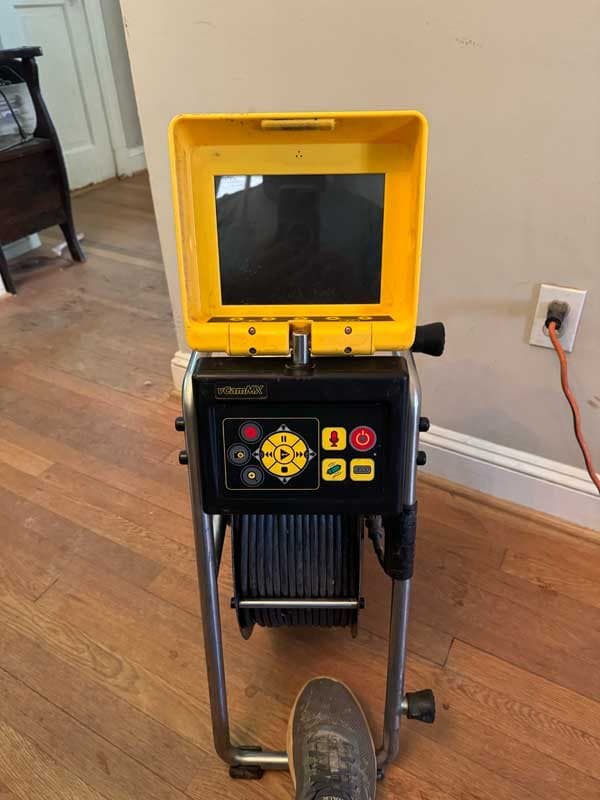
The camera sits on the end of a stiff cable that we push through the cleanout. A light on the camera head lights up the inside of the pipe, and the picture comes up on a monitor next to us in real time. A counter on the reel tells us how far in the camera is, so every problem gets a distance.
What shows up is usually one of a handful of things. Cracks and breaks in the pipe wall. Roots coming in through a joint. A belly, which is a section that has sunk so water sits in it. Offset joints where two pieces of pipe no longer line up. Heavy scale and rust inside cast iron. Grease that has built up along the wall.
Many cameras also carry a small transmitter, so we can stand in your yard with a locator and find the exact spot above the problem and how deep it is. That turns a vague guess into a mark on the lawn, which is what makes small, targeted repairs possible.
The inspection itself does not fix anything. What it does is stop you from paying for the wrong fix. Sometimes the answer is a simple cleaning. Sometimes it is one spot repair. Sometimes the line really is done. You deserve to see which before anyone quotes you.
How a camera inspection works
- 1
We find the way in
Usually an outside or basement cleanout. If the line is blocked, we clear enough of it first so the camera can travel.
- 2
We run the camera the full length
From the house toward the street connection, slowly, with the light on and the footage counter running.
- 3
We stop at anything worth a look
Cracks, roots, sags and offsets get a pause, a closer look and a distance.
- 4
We locate problem spots from above
With the transmitter and a locator we mark the spot on the ground and note the depth.
- 5
We walk you through it
You watch the footage with us and we explain what each problem means in plain terms.
- 6
You get your options
Clean it, repair one spot, reline it or replace it. With an honest read on how urgent it is.
What we see, and what it usually means
| On camera | What it means | Typical next step |
|---|---|---|
| Fine roots at a joint | Roots found a small gap and are feeding on moisture | Cleaning or jetting, and possibly a liner to seal the joints |
| Crack or small break | The wall has failed in one spot | Spot repair, often without a full trench |
| Belly with standing water | A section has sunk and holds waste | Depends on how deep the sag is, sometimes a dig and replace |
| Heavy scale in cast iron | Rust and scale have narrowed the pipe | Descaling, then a decision on lining |
| Collapsed section | The pipe has caved in | Replacement of that section |
What goes into the price of an inspection
The camera inspection is free when we go on to do your sewer repair. On its own, these are the things that affect the price.
Read the full cost guide- Access
- An easy outside cleanout is quicker than going in through a toilet or a roof vent.
- Whether the line is blocked
- A blocked line has to be opened before the camera can travel.
- Length of the run
- A long lateral to a street main takes longer to record than a short one.
- Locating
- Marking problem spots on the surface is extra time and well worth it before any digging.
At home and at work
For homeowners
For homeowners, the most common reasons are a backup that keeps coming back, a pre-purchase check, or a second opinion on a big quote. You get a clear answer and a look at the footage.
Residential servicesFor businesses and property managers
For businesses and landlords, camera work helps plan maintenance before a line fails during business hours. It also documents the condition of a line when a property changes hands.
Commercial servicesQuestions we hear about camera inspection
It is free when we do the sewer repair it leads to. If you only want the inspection, we will give you the price up front.
Yes, and we encourage it. You see the same monitor we do, and we explain what you are looking at as we go.
It is one of the smartest small costs of buying an older home. A standard home inspection rarely looks inside the sewer lateral, and a failed line can be an expensive surprise after closing.
No. It is a camera on a flexible cable. It goes in, looks, and comes out.
In most homes, yes, as long as there is a way in and the line is open enough to travel. We will tell you if something stops it and what that likely means.
Then you have peace of mind and you know the problem is somewhere else, often inside the house drain lines, which are much cheaper to deal with.
Often done together
Where we do this work

Water where it should not be?
Backups and broken lines get worse the longer water runs. Call us and tell us what you are seeing. We will tell you what to do right now and what it will take to fix it.
Monday to Friday, 8 AM to 5 PM. Free estimates on every job.