
Trenchless sewer repair and replacement
Trenchless sewer repair replaces or relines your sewer line through small access pits instead of a trench across the yard. In Damascus and across Montgomery County, that usually means the lawn, driveway and trees stay where they are. Here is how the two main no-dig methods work, and when neither one is the right call.
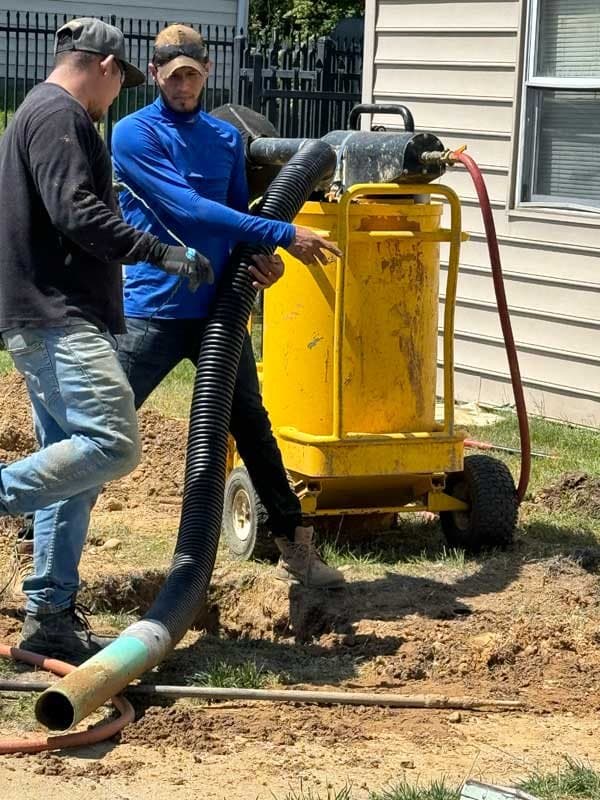
Is your line a good trenchless candidate?
Trenchless works best on lines that are damaged but still hold their shape. These are good signs.
- 01
Roots at many joints
Clay and older pipe with roots coming in at joint after joint is exactly what a jointless liner fixes.
- 02
Cracks along the run
Several cracks spread along the line make spot repairs add up fast. A liner covers them all.
- 03
Pipe under a driveway, patio or tree
Digging would mean breaking concrete or cutting roots. Trenchless goes under it.
- 04
Scaled or corroded cast iron
After descaling, a liner gives you a new pipe inside the old one.
- 05
Undersized or failing old pipe
Pipe bursting can pull in new pipe along the same path, sometimes a size up.
- 06
Landscaping you want to keep
Mature beds, hardscape and lawns are the whole reason people choose no-dig.
Pipe lining and pipe bursting, explained
Cured in place pipe lining, often called CIPP, builds a new pipe inside the old one. A flexible liner soaked in resin is pulled or inverted into the cleaned line, then inflated so it presses against the old pipe wall. Once the resin cures and hardens, you have a smooth pipe with no joints for roots to find, running the full length of the repair.
Pipe bursting replaces the pipe instead of lining it. A bursting head is pulled through the old line, breaking it apart and pushing the pieces into the surrounding soil, while a new pipe is pulled in right behind it. It works well when the old pipe is too damaged to line or too small for the house.
Both methods need access at each end of the repair. That usually means one small pit near the house or at the cleanout, and one near the connection toward the street. Everything in between stays in the ground.
Trenchless is not magic, and it is not always possible. A section that has fully collapsed stops a liner from going through. A deep belly will still hold water after lining, because the liner follows the old pipe. A line that needs to change direction or depth has to be dug. When the camera shows any of that, we will tell you plainly and talk about a spot dig or a conventional replacement instead.
Watch a liner go in, one step at a time
- 1The camera finds the damageWe feed a camera through the cleanout and record the whole line. Cracks, roots and sags show up on screen, with the distance to each one.
- 2The line gets cleaned outRoots, grease and scale are cut and flushed away so the new pipe has a clean, round surface to bond to.
- 3A new pipe forms inside the old oneA resin soaked liner is pulled into place from a small access pit and cured until it hardens into a new pipe with no joints for roots to find.
- 4Water flows, the lawn staysThe cracks are sealed inside a jointless pipe. Up top, the lawn, the driveway and the tree never got touched.
Not every pipe can be lined. Collapsed or badly sagging sections sometimes need a different fix, and we will tell you when that is the case.
A lining job, step by step
The four step animation above shows the underground part. This is the whole job.
- 1
Camera and measure
We record the line, confirm it is a lining candidate and measure the exact length.
- 2
Dig the access points
Small pits at each end of the repair, placed where the camera says they need to be.
- 3
Clean the pipe
Hydro jetting or descaling so the liner bonds to a clean wall.
- 4
Install and cure the liner
The resin soaked liner goes in and is cured until it hardens into the new pipe.
- 5
Reopen connections and camera check
Any branch connections are reopened, then we put the camera through the finished pipe.
- 6
Close up the pits
Backfill, compact and restore the surface. Two small patches instead of a trench.
Not sure trenchless is right for your line?
Our sewer line repair page covers the full range of fixes, including spot repairs and when digging is the better option. Start there if you are still weighing your choices, or if you have been told your line has collapsed.
Lining, bursting or digging
| Pipe lining (CIPP) | Pipe bursting | Open trench | |
|---|---|---|---|
| How it works | New resin pipe formed inside the old one | Old pipe split apart, new pipe pulled in behind | Dig the length of the line and lay new pipe |
| Digging | Access at each end | A pit at each end | A trench along the whole run |
| Pipe size after | Slightly smaller than before | Same size or larger | Any size |
| Handles collapse or deep sags | No | Sometimes, not deep sags | Yes |
| What stays untouched | Lawn, driveway, trees, patios | Lawn, driveway, trees, patios | Anything outside the trench |
The camera decides which column you are in. We show you the footage so the choice makes sense to you, not just to us.
What affects the cost of trenchless sewer repair
Trenchless is not always cheaper than digging on paper. The savings usually come from what you do not have to rebuild afterward, like a driveway, a patio or mature landscaping.
Read the full cost guide- Length of the repair
- Liner and pipe are priced by the foot, so length matters most.
- Pipe size and condition
- Heavy scale or roots mean more prep before lining.
- Access pits
- Depth and location of the pits, and what surface is above them.
- Connections
- Branch lines that tie into the run need to be reopened or reconnected.
At home and at work
For homeowners
For homeowners, the appeal is simple: a new sewer line without a trench across the front yard, and without breaking up a driveway you just paid for. Most of the yard never knows we were there.
Residential servicesFor businesses and property managers
For businesses, trenchless means less excavation in parking lots and walkways, shorter closures, and a work area that is far easier to keep safe for customers.
Commercial servicesThe lawn after the work
On a no-dig job, the finished site is two small patches of new soil where the access pits were. Compare that with a trench running the length of the yard, and it is easy to see why homeowners ask about trenchless first.
Questions we hear about trenchless sewer
Cured in place liners are designed for a long service life, measured in decades. The quality of the prep work and the install matters a lot, which is why we clean the pipe properly and camera check the finished liner.
No. A collapsed section, a deep belly, or a line that must change direction needs digging at least at that spot. We would rather tell you that up front than sell you a liner that will not solve the problem.
Slightly, by the thickness of the liner. Because the new surface is smooth and has no joints, flow is usually as good or better than before.
Sometimes. The biggest savings usually come from not having to replace a driveway, patio, walkway or landscaping. We can price both ways so you can compare.
Most lining jobs have the line back in service within a day. We plan water use with you ahead of time.
Lining builds a new pipe inside the old one. Bursting breaks the old pipe apart and pulls new pipe into its place. Bursting can keep or increase the pipe size, lining makes it a little smaller but needs less room at the ends.
Often done together
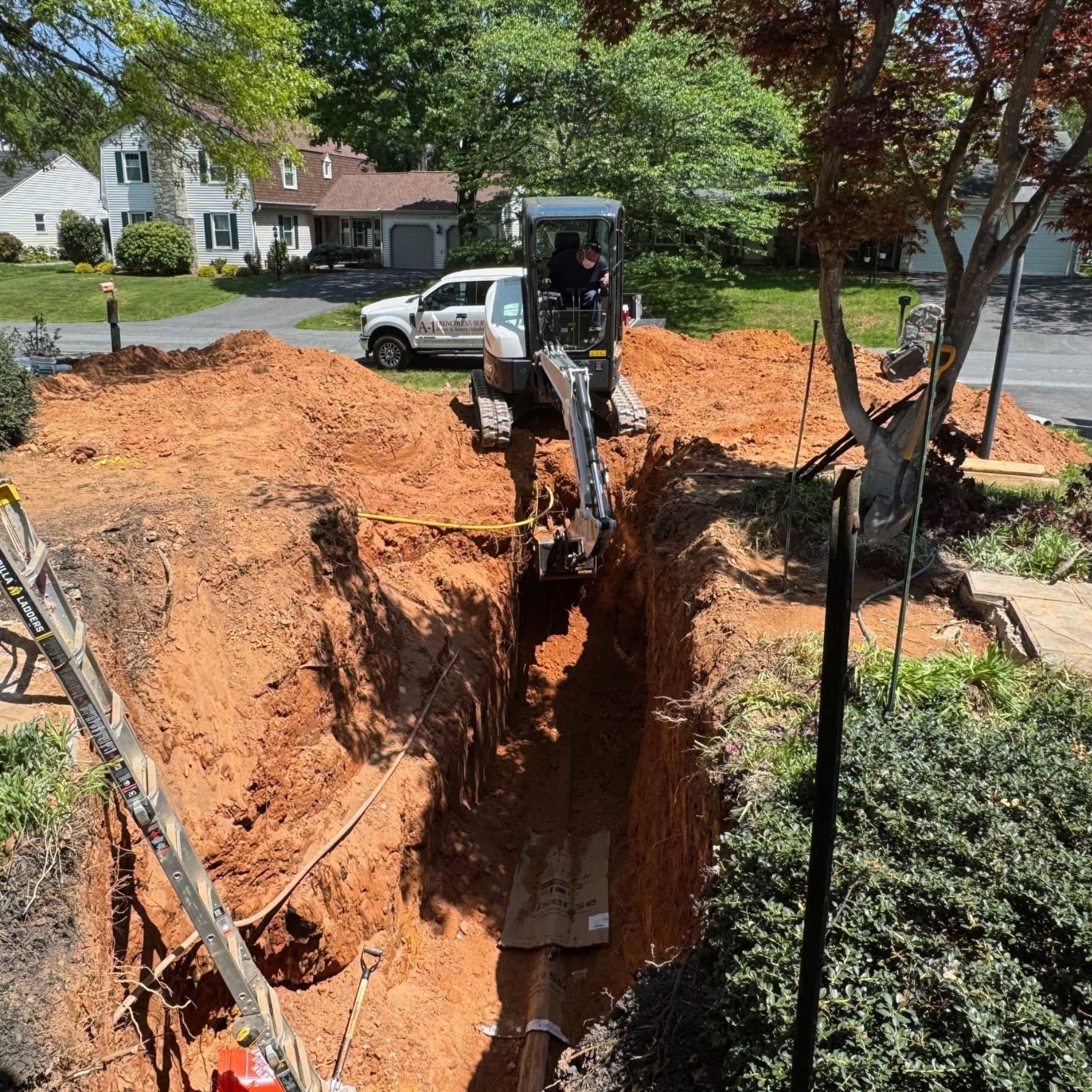

Water where it should not be?
Backups and broken lines get worse the longer water runs. Call us and tell us what you are seeing. We will tell you what to do right now and what it will take to fix it.
Monday to Friday, 8 AM to 5 PM. Free estimates on every job.