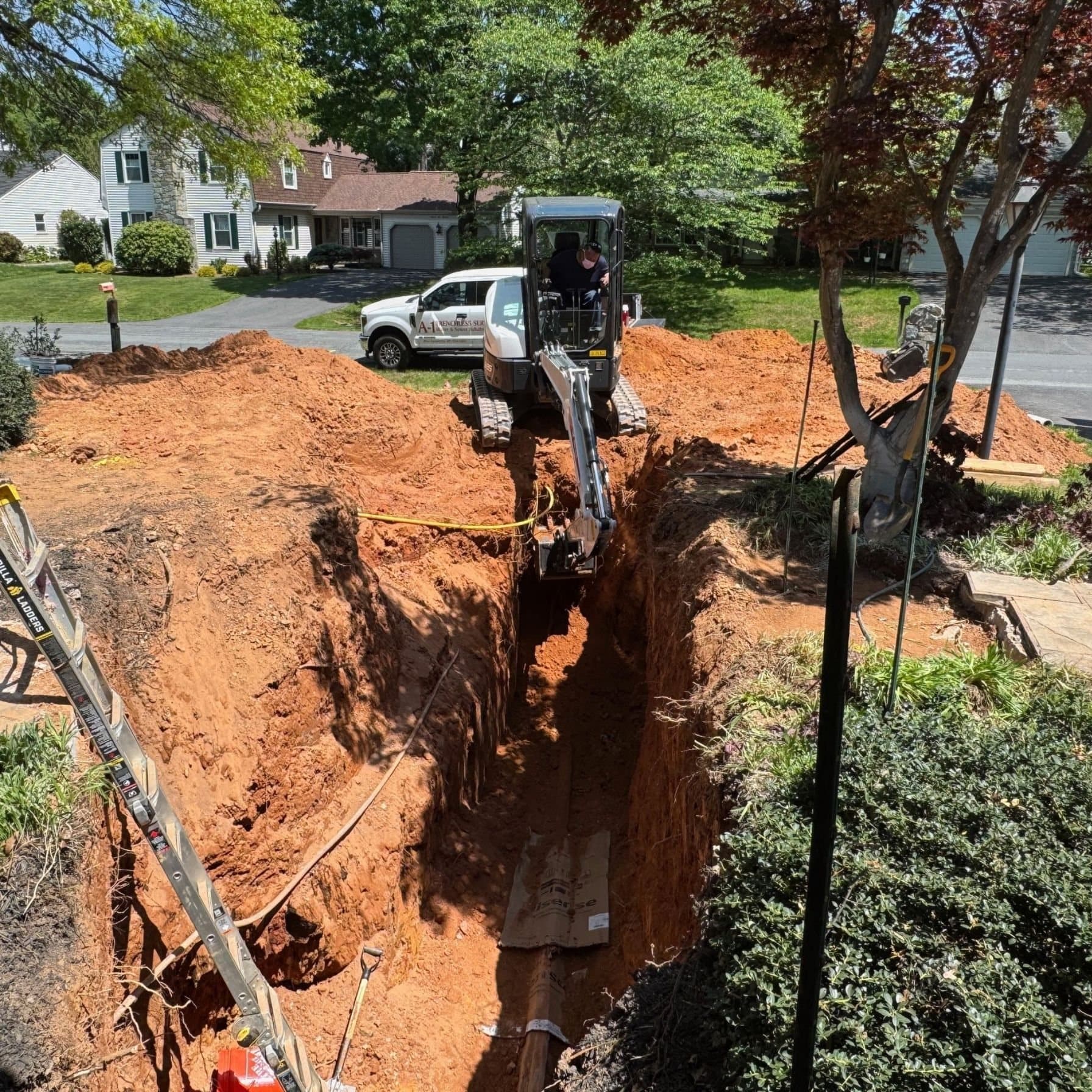
When a sewer or water line fails under a lawn, a driveway or a row of old shrubs, most Maryland homeowners ask the same first question: do you have to dig all of that up? Often the answer is no. Pipe bursting and pipe lining are the two main trenchless methods, and both can fix a buried line without opening a trench from the house to the street.
They are not interchangeable, though. One replaces the pipe and the other rebuilds it from the inside. Picking the wrong one can mean paying for a repair that does not last. This guide explains how each method works, which pipes suit each one, and what to ask any pipe bursting or lining contractor before you sign.
The short answer
Pipe bursting replaces the pipe. Pipe lining rehabilitates it.
- With pipe bursting, a cone shaped bursting head is pulled through the old pipe. It breaks the old pipe apart and pushes the pieces into the surrounding soil while a new pipe is pulled into the same path right behind it.
- With pipe lining, also called cured in place pipe or CIPP, a flexible tube soaked in resin is pulled or inverted into the old pipe and hardened in place. The result is a new, seamless pipe inside the old one.
If the old pipe still holds its shape, lining is often possible. If it is crushed, collapsed or too far gone to act as a host, bursting is usually the better choice.
How pipe bursting works, step by step
- Camera inspection. The line is inspected and measured so the crew knows its length, depth, material and any bends.
- Two small pits. One access pit is dug near the house and one near the connection at the street or main. On a typical residential lateral these are a few feet across.
- Pulling the cable. A steel cable or rods are run through the old pipe from one pit to the other.
- Bursting and pulling. The bursting head is attached to the new pipe, usually high density polyethylene, and pulled back through. The old pipe is fractured outward as the new pipe follows.
- Connections and backfill. The new pipe is connected at both ends, inspected with the camera, and the pits are filled and restored.
Because the new pipe can be the same size as the old one or larger, bursting is a good fit when you want full capacity or when the old line was undersized.
How pipe lining works, step by step
- Camera inspection. The line is checked to confirm it still has a continuous, round enough path for a liner.
- Cleaning. Roots, grease and scale are removed, often with hydro jetting or descaling, so the liner bonds to clean pipe.
- Installing the liner. A resin saturated liner is inserted through a cleanout or a small access point and pressed against the pipe wall.
- Curing. The resin hardens with heat, steam or light, depending on the system.
- Final inspection. The camera confirms the liner is smooth and fully bonded, and any branch connections are reopened.
Lining often needs little or no digging at all, which makes it attractive when the line runs under a finished basement slab, a patio or a long driveway. Our page on CIPP sewer liners goes deeper on the pros and cons.
Which method fits your pipe?
| Condition of the existing line | Better fit |
|---|---|
| Cracks, open joints, root intrusion, pipe still round | Lining |
| Collapsed or crushed sections | Bursting |
| Badly corroded cast iron that has lost its shape | Bursting |
| Brittle clay or Orangeburg pipe | Bursting, or lining if the pipe is still round |
| Line runs under a slab with no room for pits | Lining |
| Pipe is undersized and you want more capacity | Bursting |
| Sagging section that holds standing water | Neither alone, the belly needs a spot repair first |
Neither method fixes a sagging line by itself. A liner follows the old pipe, sag and all, and a burst pipe follows the old path. If the camera shows a belly, that section usually needs a short open repair before or alongside the trenchless work.
Pipe materials common in Montgomery County homes
The houses we work on around Damascus, Germantown, Olney and Rockville tend to have one of four sewer materials, and each one behaves differently:
- Clay, common in homes built before the 1970s. Strong pipe wall, weak joints, prone to roots. See our guide to clay sewer pipe repair.
- Cast iron, often inside the house and under slabs. It corrodes and scales from the inside over decades. Early on it can be descaled, later it may need lining or replacement.
- Orangeburg, a fiber pipe used in some mid century homes. It deforms over time and is usually replaced rather than lined.
- PVC, used in most newer homes and nearly all replacements.
What changes the cost
We do not quote either method sight unseen, because the price depends on details the camera reveals:
- the length and depth of the line
- the pipe diameter and material
- how much cleaning or descaling has to happen first
- how many access points are needed and what sits on top of them
- whether a sagging or collapsed section needs a spot repair as well
- permits and the connection at the public main
Lining can cost less when the host pipe is in good shape and prep is light. Bursting can be the better value when the line is too damaged for a liner to last. Either way, both usually cost less to restore afterward than a full open trench, because there is far less lawn, driveway or landscaping to rebuild. Our sewer line repair cost guide explains each factor.
Questions to ask any pipe bursting or lining contractor
Whether you hire us or someone else, these questions separate a careful contractor from one selling a single method:
- Will you show me the camera footage before and after? You should see the damage, and the finished pipe, with your own eyes.
- Why this method for my line and not the other one? A good answer refers to what the camera showed, not what the company prefers to sell.
- Can you also do a traditional excavation if the line needs it? A contractor who only has one tool tends to use it on every job.
- Is there a sag or collapsed section, and how will you handle it?
- Who handles the permit and the connection at the main?
- What does the price include for restoring the yard or driveway?
Pipe bursting and lining questions we hear most
Is pipe bursting safe near other utilities? It can be, when the crew knows where the gas, water and electric lines are. Utilities are marked before any work, and the bursting path is checked against them.
How long does a trenchless replacement take? Most residential laterals are done in one to two days, depending on length, depth and access.
Can a water line be replaced the same way? Yes. Water service lines are often replaced by pulling a new line through the path of the old one with small pits at each end. Our guide to trenchless water line replacement explains how that works.
Will lining make my pipe smaller? Slightly. The liner adds a thin wall inside the old pipe. On most residential sewer lines that does not affect flow, and the smooth inside surface often helps.
Get an honest recommendation
A-1 Trenchless Services repairs and replaces sewer and water lines across Montgomery, Prince George's, Howard and Frederick counties from our base in Damascus. We start with a camera inspection, show you what we see, and recommend the method that fits your line, including a traditional dig when that is honestly the better repair.
Request a free estimate or call (301) 254-8401.
First published . Written by the A-1 Trenchless team.